Rehearsing the Room
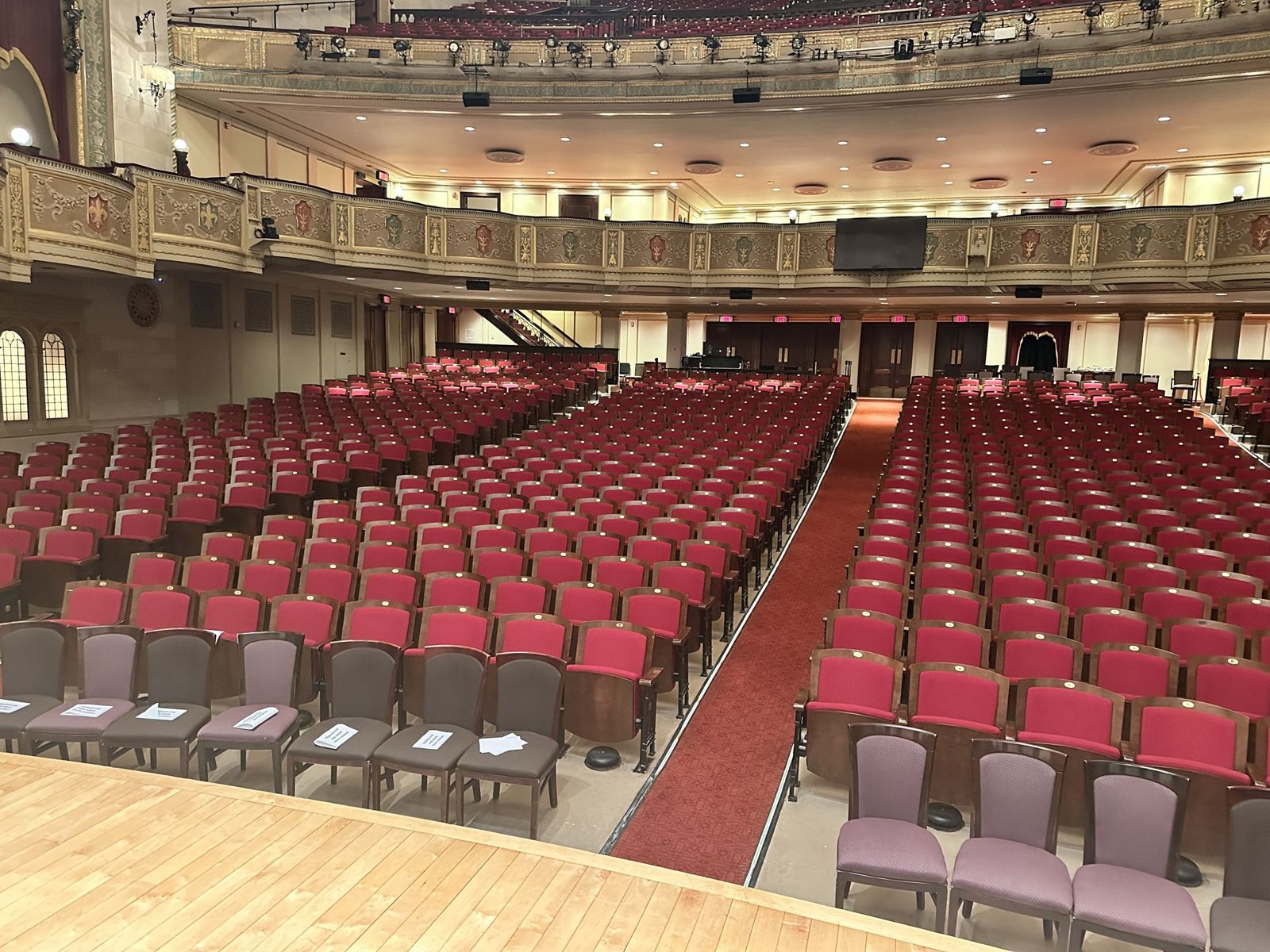
I photographed Orchestra Hall, pasted a bored audience into it, put my family in the front row, and practiced in front of it on a television in my basement.
Recently I sat in Britton Recital Hall at the University of Michigan and listened to Anıl Çamcı, who teaches performing arts technology there, explain what it took to rebuild that room, and Hill Auditorium, in virtual reality. His goal was that each hall sound correct from wherever you're standing in it. Walk toward the wall and it changes. Walk toward the audience and it changes again. His dedication to that reminded me of the way a professional musician talks about timbre, or color in their sound, chasing distinctions most listeners would never name but every player can feel.
The halls are part of Piano Lab Pro, an app for the Apple Vision Pro that lets students rehearse a performance before they ever walk out on stage. Aya Higuchi Hagelthorn, who directs collegiate class piano at the school, got the grant to build it, working with the university's Center for Academic Innovation and its Institute for Social Research. The visual reconstruction is as careful as the sound. You can walk through the rooms. The audience murmurs and coughs. The lights go down before you start.
I was in the audience with a Quest 3 in my bag, because I'd spent the past year building a much cruder version of the same idea in my basement.
Why I started
Last season I came back to the stage after enough time away that Orchestra Hall felt unfamiliar. I don't remember what caused the gap, and it probably didn't need a cause. The DSO takes the whole of August off, no rehearsals and no concerts, so a few weeks away is just the shape of the job. The room, the lights, the sightlines, the sound arriving back at me later than it does at home: all of it was different enough from the clarinet playing I'd been doing every day that the novelty took up space in my head, and the playing suffered for it. It fed the nerves, too.
You prepare in one place and deliver in another, and nothing in a normal practice routine narrows the distance between them. You get four rehearsals in the hall. Everything before that happened somewhere else. And the rehearsals only take you so far, because the hall in the morning with your colleagues in it isn't the hall at night with an audience in it, HD cameras pointed at you, and a recording that will sit on YouTube for years.
So I wondered whether I could bring the hall home.
The basement version
I had a concerto coming up, which meant standing at the front of the stage rather than sitting in my usual chair. So I took a photo of Orchestra Hall from the soloist's position, looking out at the seats, and put it on a big-screen TV in my basement. It's a view I almost never have, and I was about to have it.
Then I made it worse in a useful way. I did a Google image search for bored classical music audiences, cut faces out of the results, turned them into stickers with the markup tool on my iPhone, and stuck them all over the photo. A hall full of people who'd rather be somewhere else. I also darkened the whole image, because the hall with the house lights up looks nothing like the hall at concert time.
And then I did the thing that turned out to matter most. I put a photo of my daughter and my wife in the front row, in pajamas. The puppy too.
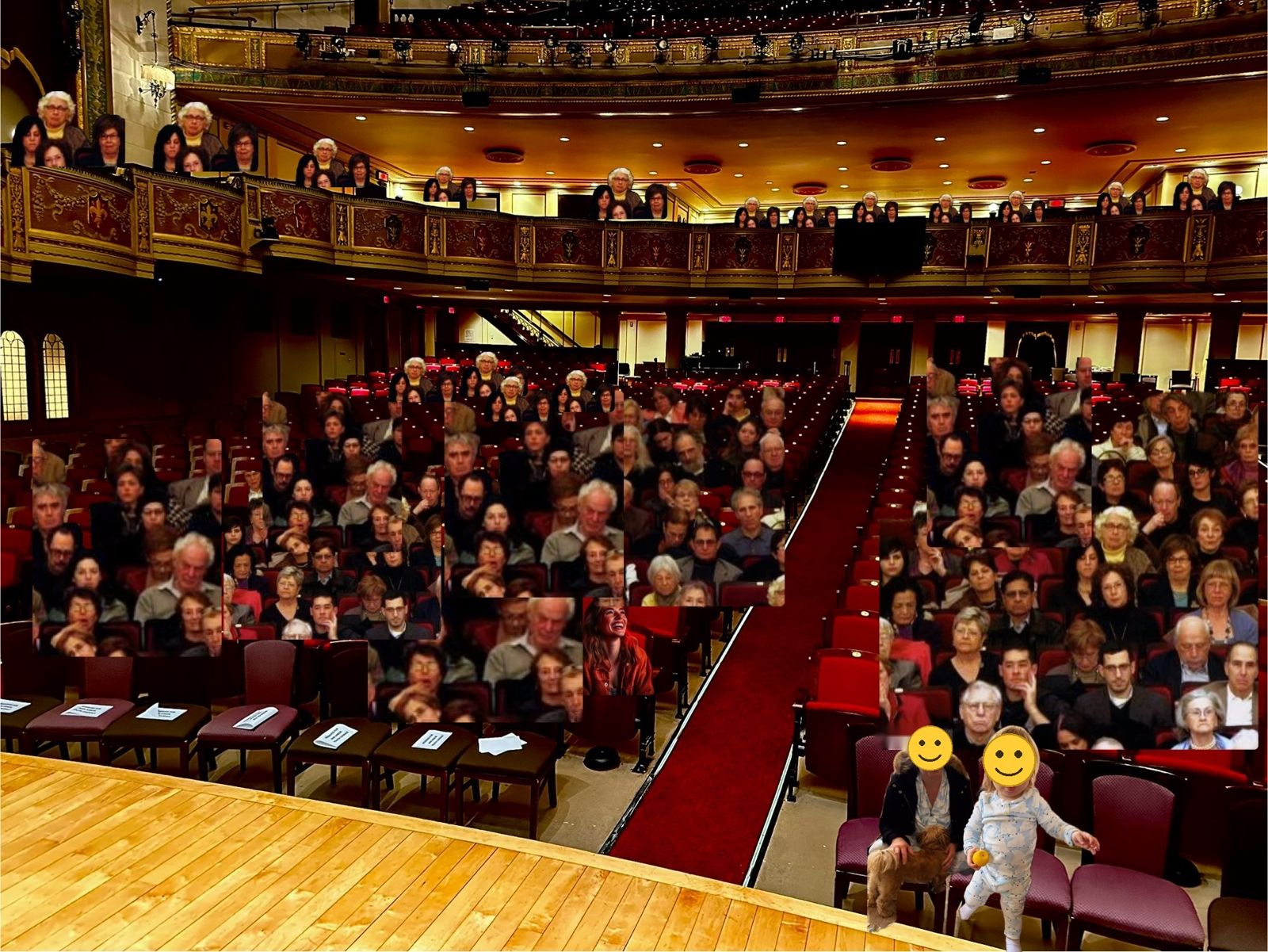
I didn't really have a strategy. I just wanted something in the picture that would make me happy. But it changed what the exercise was for. I wasn't practicing being nervous. I was practicing walking out onto that stage and finding it supportive and delightful.
When I finally walked out to play the Bruch Double Concerto for clarinet and viola, with Eric Nowlin, I smiled to myself, because I could almost see them in the front row. I'd been looking at that exact view for a month.
Total cost: a television I already owned and an afternoon on my phone.
The headset version
Once the TV worked, I wanted to know what happened if the picture surrounded me.
I got a Quest 3 and went looking for something that would put a custom environment in front of my eyes. What I landed on is Immersed, an app built for remote coworking. It's meant to give you a virtual boardroom with your monitors floating in it, and it lets you load in one custom 3D environment of your own, which is all I needed.
Getting an environment in there takes a tool called SideQuest to reach the headset's storage. I learned it from YouTube. Then, because Immersed can broadcast the screens of other devices into the space, I put the app on my iPad and my iPhone, and my sheet music was suddenly floating in front of me inside a photograph of Orchestra Hall. That's also how the conductor gets onto the podium.
Is it easy? It is for me now. It wasn't the first time, and none of these components were designed to do this.
For capture I started with an Insta360 Flow 2 Pro, a phone gimbal with a 360 Photo mode that rotates your phone through eighteen shots and stitches them into a single panorama. That panorama is the environment. I've since bought an Insta360 X5, mostly for speed, because the window for taking these photos is usually narrow. The versions shot under concert lighting are the best ones and the hardest to get.
A different kind of training
Then I used that setup to train in a different way.
There was a piece I was genuinely anxious about. I found a way to get a 360 photo from my own chair in the orchestra, with lighting close enough to a performance. Then I put the music on the stand inside that image, broadcast from my iPad, and a video of the conductor up on the podium, broadcast from my phone. Two devices feeding the image at once.
The video wasn't of the piece I was preparing. I pulled it from a broadcast of an earlier concert where the meter and the tempo were close enough that I could nudge it into line. It didn't need to be accurate. It needed to be him, on that podium, giving me an entrance I had to take.
The point was to put myself into fight or flight while I played, on purpose, in my basement, where the cost of falling apart was nothing.
Then I practiced not responding to that feeling in unhelpful ways. Over and over, until my body stopped treating it as an emergency. That was some of the most useful preparation I've ever done.
What doesn't work
A colleague tried it and got nothing out of it, because he plays the violin.
He couldn't see his hands well enough, and the passthrough video lagged enough to be a distraction. The headset also physically got in the way of the violin, so it ended up being a short experiment.
That's the thing I believed in the first month and don't believe now: that this would be useful to everybody. It isn't. I play an instrument I hold in front of me, I read from a stand, and I happen to be someone who's helped by visual familiarity. Change any of those and it may fall apart.
This has worked for me, repeatedly, and it's part of how I prepare now. I haven't run it with a student in any serious way yet, so I have no results beyond my own, and one player's experience doesn't make it true for anyone else.
If you want to try it
Start with the television.
Take the best photo you can of the hall you're going to perform in, shot from wherever you'll actually be, standing or sitting. Put it on the biggest screen you own. Darken it, because the house lights are never on when it counts. Add an audience if you want one.
What goes in after that is up to you. Two things worked for me, and they worked differently. One was putting something in the picture that made me smile. The other was repetition, getting used to feelings I knew were coming so they'd be familiar when they arrived. Both left me more comfortable in that hall, and both took weeks rather than one sitting. I don't think there are hard rules here. What works for one piece, or one week, may do nothing the next time.
If that does something for you, the headset version is worth the trouble, and the trouble is real: a Quest, SideQuest, Immersed, a 360 camera, an afternoon with YouTube. If the television does nothing for you, you've lost an afternoon and a photograph.